
Kinematic Equations: Understanding the Fundamental Formulas of Motion
Physics helps us understand how objects move, accelerate, and interact with forces. Among the most important concepts in mechanics are kinematic equations, a set of mathematical formulas used to describe the motion of objects without considering the forces causing that motion.
These equations are essential in high school physics, engineering, astronomy, and real-world applications such as vehicle design, sports science, and robotics. By understanding kinematic equations, students can solve a wide variety of motion-related problems with ease.
In this comprehensive guide, we will explore the definition of equations, their formulas, derivations, applications, and practical examples.
What Are Kinematic Equations?
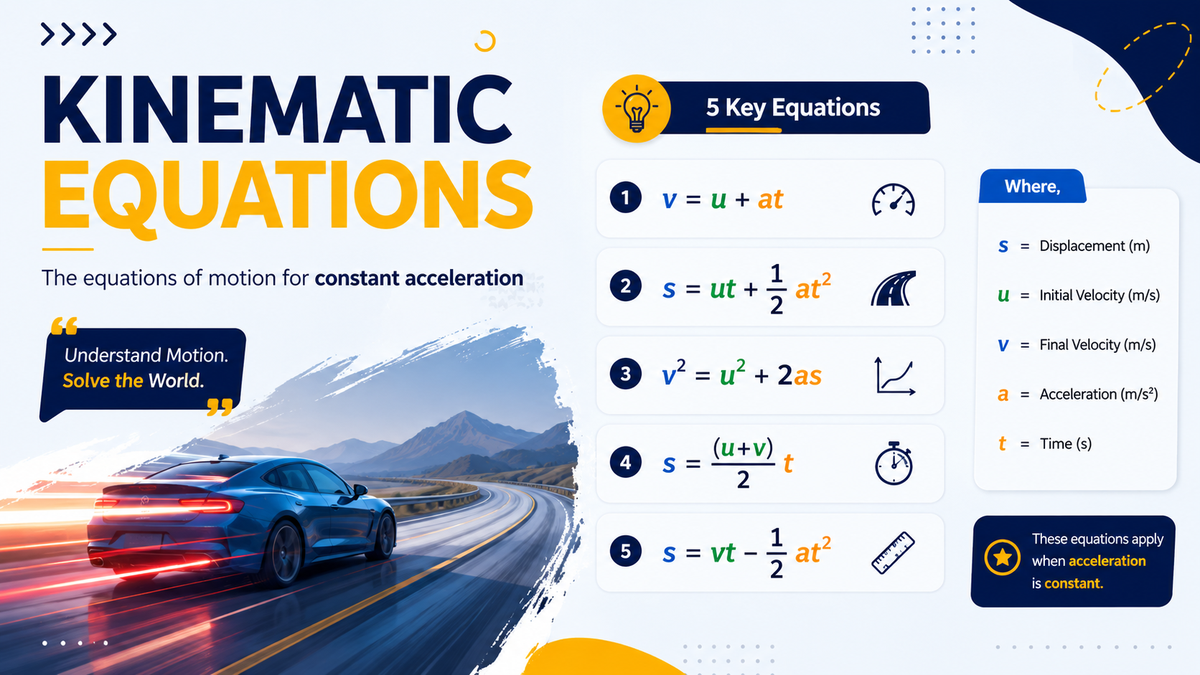
Kinematic are mathematical formulas that describe the motion of objects moving with constant acceleration. They relate five important quantities of motion:
- Initial velocity (u)
- Final velocity (v)
- Acceleration (a)
- Time (t)
- Displacement (s)
These equations belong to the branch of physics known as kinematics, which studies motion without examining the forces responsible for that motion.
equations are particularly useful when acceleration remains constant throughout the motion.
Understanding where these equations come from strengthens conceptual knowledge.
Derivation of the First Equation
Acceleration is defined as:
a = (v − u)/t
Rearranging:
v = u + at
This gives us the first equation of motion.
Derivation of the Second Equation
Average velocity is:
Average Velocity = (u + v)/2
Displacement:
s = Average Velocity × Time
Substituting v = u + at:
s = [(u + u + at)/2] × t
After simplification:
s = ut + ½at²
Derivation of the Third Equation
From:
v = u + at
We get:
t = (v − u)/a
Substituting into the displacement equation and simplifying leads to:
v² = u² + 2as
Assumptions of Kinematic Equations
Kinematic work under certain conditions:
Constant Acceleration
Acceleration must remain unchanged throughout the motion.
Straight-Line Motion
The object should move in one dimension.
Negligible External Factors
Air resistance and friction are generally ignored.
If these assumptions are violated, more advanced methods of analysis become necessary.
Importance of Kinematic Equations
Equations form the foundation of classical mechanics and have numerous practical applications.
Problem Solving
They allow students and scientists to calculate displacement, speed, and acceleration efficiently.
Engineering Design
Mechanical and civil engineers use these equations when designing transportation systems and machinery.
Scientific Research
Researchers rely on motion equations to model physical phenomena.
Educational Foundation
Understanding kinematics prepares students for advanced topics such as dynamics, energy, and rotational motion.
Real-Life Applications of Kinematic Equations
Many everyday activities involve kinematic principles.
Automobile Engineering
Engineers calculate braking distances, acceleration rates, and fuel efficiency using equations.
Sports Science
Coaches analyze the movement of athletes to improve performance and reduce injuries.
Space Exploration
Scientists determine spacecraft trajectories and orbital maneuvers.
Robotics
Robots depend on precise motion calculations for navigation and task execution.
Construction Industry
Heavy machinery movement and elevator systems are designed using kinematic principles.
Kinematic Equations in Free Fall
Objects falling under gravity follow the same equations of motion.
In free-fall situations:
- Acceleration (a) = 9.8 m/s²
- Initial velocity may be zero
- Motion occurs vertically
Example
A stone is dropped from a height.
Given:
u = 0
a = 9.8 m/s²
t = 3 seconds
Using the displacement equation:
s = 0 + ½ × 9.8 × 3²
s = 44.1 meters
The stone falls approximately 44.1 meters.
Graphical Interpretation of Kinematics
Position-Time Graph
Shows how displacement changes with time.
Velocity-Time Graph
The slope of the graph represents acceleration.
Acceleration-Time Graph
Illustrates how acceleration varies over time.
Graphical analysis provides a visual understanding of motion and complements mathematical calculations.
Common Mistakes When Using Kinematic Equations
Students often make errors while solving kinematics problems.
Using Incorrect Signs
Direction matters in physics. Positive and negative signs should be assigned carefully.
Selecting the Wrong Equation
Choose the equation based on the known and unknown variables.
Mixing Units
Always use standard SI units:
- Distance: meters (m)
- Time: seconds (s)
- Velocity: meters per second (m/s)
- Acceleration: meters per second squared (m/s²)
Ignoring Assumptions
Kinematic equations only apply when acceleration remains constant.
Tips for Mastering Kinematic Equations
Memorize the Formulas
Understanding the relationship between variables makes solving problems easier.
Practice Numerical Problems
Regular problem-solving improves speed and accuracy.
Draw Diagrams
Visual representations help identify known and unknown quantities.
Understand Concepts
Memorization alone is not enough. Focus on understanding the physical meaning of each equation.
Conclusion
Kinematic equations are among the most important tools in physics. They provide a mathematical framework for describing motion and enable scientists, engineers, and students to predict how objects move under constant acceleration.
From calculating the speed of a moving vehicle to designing spacecraft and robotic systems, these equations have transformed science and technology. Mastering equations not only improves problem-solving skills but also builds a strong foundation for advanced studies in physics and engineering.
Frequently Asked Questions (FAQs)
What are kinematic equations?
Kinematic equations are formulas used to describe the motion of objects moving with constant acceleration without considering the forces involved.
How many kinematic equations are there?
There are three primary kinematic equations used in one-dimensional motion.
When can kinematic equations be used?
They can be used when acceleration is constant and motion occurs in a straight line.
What is displacement in kinematics?
Displacement is the change in an object’s position from its starting point to its final position.
Are kinematic equations used in real life?
Yes. They are widely used in engineering, sports science, robotics, transportation, and space exploration.
Why are kinematic equations important in physics?
They provide a systematic method for analyzing motion and form the basis of classical mechanics and advanced physics studies.