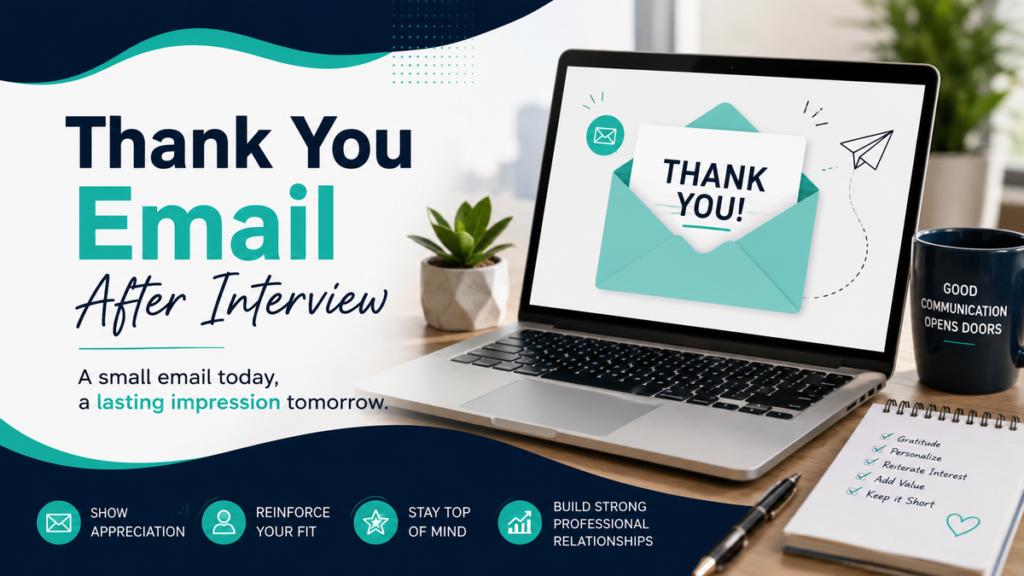
A job interview is one of the most important steps in the hiring process, but many candidates mistakenly believe their work is complete once they leave the interview room. In reality, what happens after the interview can be just as important as the interview itself. One of the simplest yet most powerful ways to leave a lasting impression is by sending a professional thank you email after interview.
Hiring managers often interview several qualified candidates for a single position. While experience, skills, and qualifications play a significant role, professionalism, communication, and enthusiasm can become deciding factors. A thoughtful follow-up email demonstrates gratitude, confidence, attention to detail, and genuine interest in the role.
Many employers appreciate candidates who take the initiative to send a thank you email because it reflects strong interpersonal skills and workplace etiquette. Even if the interview went well, a personalized follow-up can reinforce your strengths, clarify any points you may have missed, and remind the hiring manager why you are the ideal candidate.
Why Sending a Thank You Email After an Interview Matters
A thank you email is much more than a polite gesture. It serves as an extension of your interview and gives you another opportunity to communicate your value to the employer.
Recruiters and hiring managers spend considerable time interviewing candidates. A sincere thank you acknowledges their time and effort while reinforcing your professionalism.
Here are some reasons why sending a thank you email is beneficial:
It Demonstrates Professionalism
Professional communication is valued in every industry. Sending a follow-up email shows that you understand business etiquette and respect the interviewer’s time.
Employers often look for candidates who can communicate effectively in professional environments. A well-written thank you email highlights this important skill.
It Reinforces Your Interest
During interviews, hiring managers often assess whether candidates genuinely want the position.
A personalized thank you email confirms your enthusiasm and reminds the employer that you’re excited about contributing to the organization.
It Helps You Stay Memorable
Hiring managers frequently interview multiple candidates over several days or even weeks.
A thoughtful follow-up message keeps your name fresh in their minds and distinguishes you from applicants who never send one.
It Gives You Another Opportunity to Sell Yourself
Interviews rarely go perfectly.
Perhaps you forgot to mention an important accomplishment or didn’t fully explain one of your skills.
Your thank you email provides a natural opportunity to reinforce your qualifications without appearing overly aggressive.
It Builds Relationships
Recruitment isn’t just about filling positions—it’s about building long-term professional relationships.
Even if you aren’t selected for the current role, making a positive impression could lead to future opportunities within the company.
Do Thank You Emails Actually Increase Hiring Chances?
One of the most common questions job seekers ask is whether sending a thank you email truly influences hiring decisions.
The answer depends on several factors, but in many situations, it absolutely can.
While a thank you email cannot compensate for poor qualifications or a weak interview, it can positively influence employers when candidates have similar experience and skills.
Imagine two equally qualified applicants.
One candidate simply waits for a response.
The other sends a personalized email expressing gratitude, highlighting specific discussion points, and reaffirming interest in the position.
Which candidate leaves a stronger impression?
Most hiring managers appreciate candidates who demonstrate professionalism beyond the interview itself.
Although not every recruiter expects a thank you email, very few view one negatively when it’s written appropriately.
The Best Time to Send a Thank You Email After an Interview
Timing is critical.
Send your thank you email too quickly, and it may appear rushed or generic.
Wait too long, and the interviewer may already be making hiring decisions.
The ideal time is within 24 hours after your interview.
This timeframe ensures that:
- The interview is still fresh in everyone’s memory.
- Your enthusiasm appears genuine.
- You remain top of mind during candidate evaluations.
- Your professionalism stands out.
For morning interviews, sending your email later that afternoon is often ideal.
For afternoon interviews, the following morning is perfectly acceptable.
Avoid waiting more than 48 hours unless there are exceptional circumstances.
Who Should Receive the Thank You Email?
Many interviews involve multiple participants.
Whenever possible, send an individual thank you email to every person who interviewed you.
This may include:
Hiring Manager
The hiring manager is typically your primary contact and should always receive a personalized follow-up.
Mention specific topics discussed during your conversation.
HR Recruiter
Recruiters coordinate the hiring process and appreciate professional communication.
Even a shorter thank you email can strengthen your relationship with them.
Department Managers
If multiple department leaders participated in your interview, acknowledge each person’s unique questions or insights.
Personalization demonstrates genuine attention rather than copying the same message.
Panel Interview Members
For panel interviews, individual emails are generally preferred over one group email.
Tailor each message by referencing something unique from that interviewer’s conversation.
Essential Elements of an Effective Thank You Email
Writing an outstanding thank you email doesn’t require complicated language.
Instead, focus on authenticity, clarity, and professionalism.
Every effective thank you email should include several key components.
A Professional Subject Line
Your subject line should be simple and direct.
Examples include:
- Thank You for the Interview
- Thank You for Your Time
- Appreciation for Today’s Interview
- Thank You – Marketing Manager Interview
- Thank You for Meeting With Me
Avoid creative or overly casual subject lines.
Professionalism is always the safest approach.
Personalized Greeting
Address the interviewer by name.
Using their proper title demonstrates respect.
Examples:
Dear Ms. Johnson,
Dear Mr. Ahmed,
Hello Sarah,
Ensure you spell names correctly before sending your email.
Express Gratitude
Begin by sincerely thanking the interviewer for taking the time to meet with you.
Be genuine rather than overly formal.
For example:
“Thank you for taking the time to meet with me today. I truly enjoyed learning more about your team and the exciting opportunities within your organization.”
Mention Something Specific
Personalization is what separates an effective thank you email from a generic template.
Reference a specific conversation, project, challenge, company initiative, or topic discussed during the interview.
Doing so demonstrates attentiveness and genuine interest.
Reinforce Your Qualifications
Briefly remind the employer why you’re a strong candidate.
Focus on one or two skills that align with the company’s needs.
Avoid repeating your entire résumé.
Reaffirm Your Interest
Clearly state that you’re excited about the opportunity.
Employers appreciate candidates who show enthusiasm without appearing desperate.
Offer Additional Information
Let the interviewer know you’re happy to provide references, work samples, certifications, or answer further questions if needed.
Professional Closing
Finish with appreciation and a polite sign-off.
Examples include:
Kind regards,
Best regards,
Sincerely,
Thank you again,
Follow your closing with your full name and contact information.
Advanced Tips for Writing an Outstanding Thank You Email After an Interview
A standard thank you email is better than sending nothing, but a strategic and personalized email can significantly improve your chances of leaving a memorable impression. Employers appreciate candidates who demonstrate professionalism, attention to detail, and genuine enthusiasm.
Personalize Every Email
Avoid copying and pasting the same message for every interviewer. Instead, mention a unique topic that came up during your conversation. For example, reference a project the team is working on, a challenge the company is trying to solve, or an aspect of the company culture that excited you.
This level of personalization shows that you were actively engaged throughout the interview and genuinely interested in the role.
Keep It Concise
Hiring managers are busy professionals. Your thank you email should typically be between 150 and 300 words. Focus on appreciation, enthusiasm, and one or two key reminders about why you’re a great fit.
A concise email is more likely to be read in its entirety than a lengthy one.
Maintain a Professional Tone
Even if the interview was relaxed and conversational, your email should remain professional. Avoid slang, emojis, or overly casual language. Strike a balance between warmth and professionalism to leave a positive impression.
Reinforce Your Value
Rather than simply saying, “I think I’m a good fit,” remind the interviewer of a specific skill or experience that aligns with the role. Mention how your background can help solve the company’s challenges or contribute to its goals.
Proofread Before Sending
Grammar mistakes, spelling errors, or incorrect names can undermine an otherwise excellent email. Read your message carefully before sending it, and double-check the spelling of the interviewer’s name and company.
Thank You Email Template After an Interview
Below is a professional template you can customize for almost any interview.
Subject: Thank You for the Interview
Dear [Interviewer’s Name],
Thank you for taking the time to meet with me today regarding the [Job Title] position. I truly enjoyed learning more about your team, the company, and the exciting opportunities within the role.
Our discussion about [specific topic discussed] further strengthened my interest in joining your organization. I believe my experience in [relevant skill or experience] would allow me to make a meaningful contribution to your team.
I appreciate the opportunity to interview and thank you again for your valuable time. Please let me know if I can provide any additional information to assist in your decision-making process.
I look forward to hearing from you.
Best regards,
[Your Name]
[Phone Number]
[Email Address]
Short Thank You Email Example
Sometimes a brief email is all that’s needed.
Subject: Thank You
Dear Ms. Anderson,
Thank you for taking the time to speak with me today. I enjoyed learning more about your team and the Marketing Coordinator position.
Our conversation confirmed my excitement about the opportunity, and I appreciate the chance to discuss how my skills and experience align with your needs.
Thank you again for your time and consideration. I look forward to hearing from you soon.
Kind regards,
John Smith
Thank You Email After a Virtual Interview
Virtual interviews have become increasingly common, but the follow-up process remains equally important.
Mention something positive about the online conversation while keeping the structure professional.
Example opening:
“Thank you for taking the time to meet with me virtually today. I appreciated the opportunity to learn more about your organization and discuss how my experience aligns with your team’s goals.”
Thank You Email After a Phone Interview
A phone interview is often the first stage of the hiring process. Sending a thank you email demonstrates professionalism and keeps you on the recruiter’s radar.
Express appreciation for the opportunity and mention your continued interest in moving forward.
Thank You Email After a Panel Interview
If multiple people interviewed you, send personalized emails to each interviewer individually.
Mention something unique from each conversation rather than sending identical messages.
This extra effort shows attention to detail and genuine appreciation.
Industry-Specific Thank You Email Tips
Different industries may value different qualities. Tailoring your message accordingly can make it even more effective.
Corporate and Business Roles
Highlight professionalism, communication skills, leadership abilities, and your commitment to contributing to organizational goals.
Information Technology
Mention technical discussions, problem-solving abilities, software expertise, or innovative ideas discussed during the interview.
Healthcare
Emphasize compassion, teamwork, patient care, and dedication to maintaining high professional standards.
Education
Focus on student success, collaboration with colleagues, curriculum development, and creating positive learning environments.
Sales and Marketing
Reinforce your communication skills, creativity, relationship-building abilities, and measurable achievements.
Customer Service
Highlight empathy, problem-solving, conflict resolution, and delivering exceptional customer experiences.
Common Mistakes to Avoid
Even well-intentioned thank you emails can become ineffective if they include avoidable mistakes.
Waiting Too Long
Sending your email several days after the interview reduces its impact. Aim to send it within 24 hours.
Using Generic Templates
Employers can quickly recognize copied templates. Personalize every email with details specific to your conversation.
Making the Email Too Long
Your thank you email should be concise. Avoid repeating your entire resume or covering every interview question again.
Forgetting to Express Enthusiasm
Employers want candidates who are genuinely excited about the opportunity. Clearly state your continued interest.
Asking About the Hiring Decision Immediately
Avoid pressuring the interviewer by asking whether you’ve been selected. Instead, thank them and allow the hiring process to continue naturally.
Including Spelling or Grammar Errors
Professional communication requires careful proofreading. Mistakes can leave a negative impression.
Sounding Desperate
Confidence is attractive. Express enthusiasm without appearing overly anxious or demanding.
Follow-Up Strategy If You Don’t Hear Back
Sometimes employers need additional time to complete interviews or make hiring decisions.
If you haven’t received an update after the timeline they provided, it’s appropriate to send a polite follow-up email.
Wait approximately one week after the expected decision date before reaching out.
Your follow-up should remain courteous and professional.
Example:
“I hope you’re doing well. I wanted to follow up regarding the [Position] interview and express my continued interest in joining your team. I appreciate your time throughout the hiring process and look forward to any updates you can share.”
Avoid sending multiple follow-up emails within short periods.
Additional Tips for Standing Out
Small details can make a significant difference during the hiring process.
- Send your thank you email from a professional email address.
- Use a clear and simple subject line.
- Mention one memorable discussion from the interview.
- Express genuine excitement without exaggeration.
- Keep formatting clean and easy to read.
- Double-check all names and job titles.
- End with a professional signature.
- Send the email during normal business hours whenever possible.
Why Some Candidates Skip Thank You Emails
Many applicants mistakenly assume that thank you emails are outdated or unnecessary. Others worry about saying the wrong thing or believe their interview performance alone is enough.
However, sending a thoughtful follow-up requires only a few minutes and can help differentiate you from equally qualified candidates. It demonstrates initiative, professionalism, and respect—qualities that employers value in nearly every industry.
Frequently Asked Questions
Should I always send a thank you email after an interview?
Yes. Sending a thank you email is considered a professional courtesy and gives you another opportunity to reinforce your qualifications and enthusiasm for the position.
How soon should I send a thank you email?
The ideal timeframe is within 24 hours after your interview. This keeps your conversation fresh in the interviewer’s mind and demonstrates prompt professionalism.
Can a thank you email improve my chances of getting hired?
While it won’t replace strong qualifications or interview performance, a personalized thank you email can help you stand out from other candidates and leave a lasting positive impression.
How long should a thank you email be?
Aim for 150–300 words. Keep your message concise, professional, and focused on appreciation, enthusiasm, and your suitability for the role.
Should I send separate emails if multiple people interviewed me?
Yes. Send an individual email to each interviewer, referencing something specific from your conversation with that person.
Conclusion
Sending a thank you email after an interview is one of the simplest yet most effective ways to strengthen your candidacy. It demonstrates professionalism, gratitude, strong communication skills, and genuine interest in the position. While it may seem like a small gesture, it often leaves a lasting impression on hiring managers and can help distinguish you from equally qualified applicants.
The most effective thank you emails are timely, personalized, concise, and focused on reinforcing the value you bring to the organization. By mentioning specific interview discussions, expressing appreciation for the interviewer’s time, and reaffirming your enthusiasm for the role, you create another opportunity to showcase your professionalism and commitment.