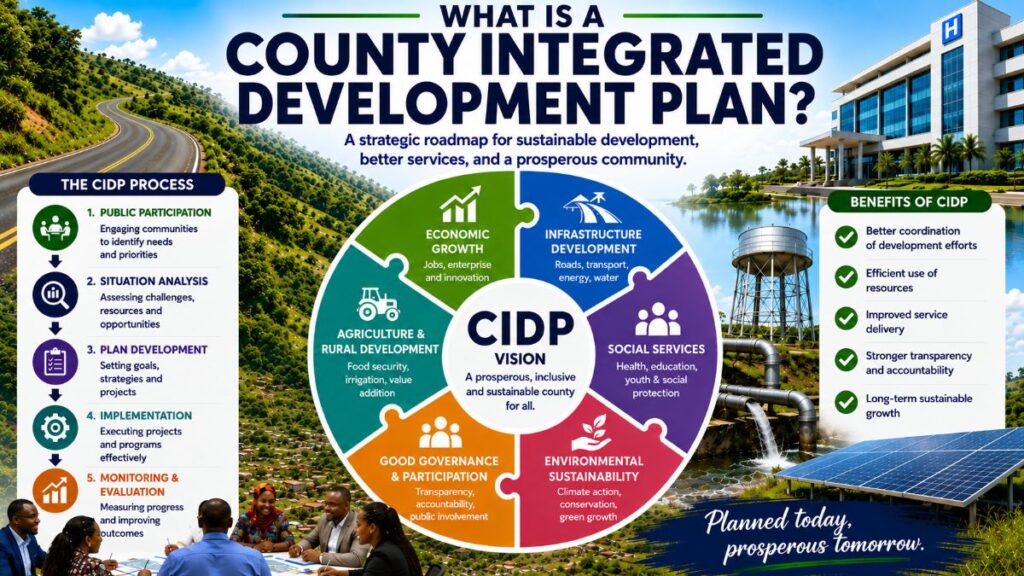
What Is a County Integrated Development Plan? A Complete Guide to CIDP
A County Integrated Development Plan (CIDP) is the primary strategic planning document that guides the social, economic, environmental, and infrastructural development of a county over a defined planning period—typically five years. It establishes priorities, identifies development challenges, allocates resources, and aligns local government programs with national development goals. For citizens, investors, policymakers, and development partners, the CIDP serves as a roadmap explaining where public resources will be invested and how communities are expected to benefit.
Understanding what a County Integrated Development Plan is matters because it influences nearly every aspect of local governance. Roads, schools, hospitals, water systems, agricultural support, environmental conservation, housing, disaster preparedness, and economic development initiatives are often guided by the priorities established in the plan. Rather than allowing departments to work independently, the CIDP integrates their objectives into a coordinated strategy designed to maximize public benefit and improve accountability.
This article examines the purpose of County Integrated Development Plans, how they are developed, why they matter for governance, the planning process, implementation challenges, monitoring mechanisms, and the evolving role these plans play in shaping resilient and inclusive communities.
Understanding the County Integrated Development Plan
A County Integrated Development Plan is far more than a collection of proposed projects. It is a comprehensive policy framework that coordinates economic planning, land use, public investment, environmental management, infrastructure development, and service delivery into one coherent strategy.
The concept of “integration” distinguishes the CIDP from traditional departmental planning. Rather than having health, education, transportation, agriculture, and environmental agencies operate independently, the plan aligns their priorities so that development efforts reinforce one another.
For example, constructing a new agricultural market may also require improved roads, expanded electricity access, better water supply, enhanced public health facilities, and vocational training for local entrepreneurs. The CIDP ensures these interconnected investments are planned collectively rather than separately.
Ultimately, the CIDP functions as both a policy guide and an investment strategy, helping counties allocate limited public resources where they generate the greatest long-term value.
Why County Integrated Development Plans Matter
Effective local governance depends on thoughtful planning rather than reactive decision-making. Without a comprehensive development framework, infrastructure investments may become fragmented, public resources may be duplicated, and long-term goals may be sacrificed for short-term political priorities.
County Integrated Development Plans address these risks by establishing measurable objectives supported by evidence-based planning.
The CIDP also strengthens transparency. Citizens gain greater visibility into planned government investments, enabling communities to monitor implementation and hold public officials accountable.
Former United Nations Secretary-General Kofi Annan once remarked:
“Good governance is perhaps the single most important factor in eradicating poverty and promoting development.”
This observation reflects the broader purpose of integrated planning: improving public service delivery through better coordination, accountability, and strategic investment.
Key Objectives of a County Integrated Development Plan
Although priorities differ among jurisdictions, most County Integrated Development Plans pursue similar strategic objectives.
| Objective | Purpose | Expected Outcome |
|---|---|---|
| Economic Growth | Support business and employment | Increased local income |
| Infrastructure Development | Improve transportation and utilities | Better connectivity |
| Social Services | Expand healthcare and education | Improved quality of life |
| Environmental Protection | Promote sustainability | Resource conservation |
| Public Participation | Engage communities | Transparent governance |
| Disaster Preparedness | Strengthen resilience | Reduced vulnerability |
These objectives recognize that sustainable development requires balanced investment across multiple sectors rather than isolated projects.
Infrastructure alone cannot generate inclusive growth without education, healthcare, environmental stewardship, and effective institutions.
Legal and Policy Foundations
County Integrated Development Plans generally operate within constitutional, legislative, and policy frameworks established by national governments.
For example, in Kenya, the Constitution of 2010 introduced devolved county governments responsible for preparing County Integrated Development Plans under the County Governments Act, 2012. The Act requires counties to prepare integrated planning documents that guide budgeting and development implementation.
Similar integrated planning systems exist in many countries under different names, reflecting global recognition that decentralized governance requires coordinated local planning.
International organizations including the United Nations Development Programme (UNDP) and the World Bank encourage integrated planning because it strengthens accountability, promotes efficient resource allocation, and supports sustainable development.
Core Components of a County Integrated Development Plan
Although formats vary, most County Integrated Development Plans include several common elements.
- County profile
- Population analysis
- Economic assessment
- Infrastructure inventory
- Environmental assessment
- Sector priorities
- Development strategies
- Investment framework
- Budget projections
- Monitoring and evaluation mechanisms
- Risk assessment
- Public participation findings
Together, these components provide policymakers with a comprehensive understanding of current conditions while identifying opportunities for future growth.
The planning process often combines statistical analysis, stakeholder consultations, community meetings, geographic information systems (GIS), demographic projections, and financial forecasting.
Public Participation: The Foundation of Integrated Planning
One defining feature of modern County Integrated Development Plans is public participation.
Communities are no longer viewed merely as beneficiaries of development projects but as active participants in shaping local priorities.
Public consultations may include town hall meetings, stakeholder workshops, surveys, focus groups, online feedback platforms, youth forums, women’s organizations, business associations, and civil society representatives.
This collaborative approach improves both legitimacy and implementation.
Development economist Amartya Sen has argued:
“Development requires the removal of major sources of unfreedom.”
Inclusive planning contributes to that vision by giving citizens meaningful opportunities to influence decisions affecting their communities.
Public participation also helps governments identify local knowledge that may not appear in statistical reports, improving the quality of planning decisions.
From Planning to Implementation
Developing a County Integrated Development Plan represents only the beginning of the governance process.
Implementation requires translating strategic priorities into annual budgets, procurement plans, engineering designs, staffing decisions, regulatory reforms, and measurable projects.
County departments coordinate their annual work plans with the CIDP to ensure consistency between policy objectives and actual expenditures.
Monitoring systems track project progress through performance indicators, financial reporting, milestone reviews, and periodic evaluations.
Political commitment, institutional capacity, technical expertise, and financial discipline therefore remain essential for successful execution.
Challenges in Preparing and Implementing County Integrated Development Plans
While the County Integrated Development Plan provides a comprehensive framework for development, turning that vision into reality is rarely straightforward. Counties often face financial constraints that limit their ability to implement every proposed project within the planning cycle. Revenue collection may fall below projections, national government transfers can be delayed, and unexpected emergencies such as floods, droughts, or public health crises may force governments to redirect resources.
Political transitions present another challenge. New administrations may introduce different priorities, requiring revisions to ongoing projects while attempting to balance campaign promises with long-term strategic objectives. Successful counties therefore build broad stakeholder support so that development priorities remain consistent beyond individual political terms.
Monitoring and Evaluation: Measuring Progress
A County Integrated Development Plan is effective only if governments continuously measure whether planned objectives are being achieved. Monitoring and evaluation (M&E) provide this accountability by tracking implementation, identifying obstacles, and informing future decision-making.
Performance indicators commonly measure infrastructure completed, healthcare access, school enrollment, agricultural productivity, water coverage, environmental conservation, and economic growth. These indicators allow governments to compare planned outcomes with actual achievements throughout the implementation period.
| Monitoring Area | Example Indicators | Purpose |
|---|---|---|
| Infrastructure | Roads completed, bridges constructed | Track physical development |
| Health | Hospital coverage, maternal health | Improve healthcare services |
| Education | School enrollment, literacy rates | Measure educational progress |
| Water & Sanitation | Households with clean water | Expand essential services |
| Agriculture | Crop productivity, irrigation | Strengthen food security |
| Finance | Budget absorption, project completion | Improve accountability |
Regular evaluation also promotes transparency by enabling citizens, oversight institutions, and development partners to review government performance against publicly stated commitments.
Sustainable Development and Environmental Planning
Modern County Integrated Development Plans increasingly recognize that economic growth cannot occur at the expense of environmental sustainability. Climate change, biodiversity loss, water scarcity, and rapid urbanization have made environmental planning a central component of local development strategies.
Counties now integrate climate adaptation measures into infrastructure planning by considering flood risks, drought resilience, watershed protection, renewable energy, waste management, and sustainable land use. Green infrastructure—such as urban parks, tree planting, wetland conservation, and improved drainage systems—helps communities adapt to changing environmental conditions while enhancing quality of life.
Former United Nations Secretary-General Ban Ki-moon emphasized the importance of sustainability when he stated:
“There is no Plan B because there is no Planet B.”
This principle reflects why environmental stewardship is no longer treated as a separate policy area but as an integral part of transportation, housing, agriculture, and public health planning within the CIDP.
Digital Transformation in County Planning
Technology has fundamentally changed how counties prepare, implement, and monitor development plans. Geographic Information Systems (GIS), satellite imagery, digital mapping, electronic procurement platforms, and open-data portals enable governments to make more informed decisions while improving public transparency.
GIS technology helps planners identify suitable locations for schools, hospitals, roads, and water infrastructure based on population density, environmental conditions, and projected growth. Digital dashboards allow county officials to monitor project implementation in real time, while online citizen portals encourage greater public participation by enabling residents to submit feedback without attending physical meetings.
As digital tools continue evolving, evidence-based planning is becoming more accurate, efficient, and responsive to community needs.
The Relationship Between CIDPs and the Sustainable Development Goals
County Integrated Development Plans increasingly align with the United Nations Sustainable Development Goals (SDGs), adopted by all UN Member States in 2015. Many county governments use the SDGs as a framework for setting priorities related to poverty reduction, quality education, healthcare, clean water, gender equality, economic growth, climate action, and sustainable cities.
Aligning local development plans with the SDGs offers several advantages. It creates consistency between local and national priorities, facilitates international development partnerships, and enables governments to measure progress using globally recognized indicators.
For example, investments in rural roads may support economic growth (SDG 8), improve food security (SDG 2), and enhance access to education (SDG 4). Similarly, expanding healthcare facilities contributes to SDG 3 while strengthening community resilience.
This integrated approach demonstrates how local planning decisions collectively contribute to broader national and international development objectives.
The Role of Community Partnerships
Government alone cannot achieve every objective outlined in a County Integrated Development Plan. Partnerships with businesses, universities, nonprofit organizations, faith-based institutions, community groups, and international development agencies significantly expand implementation capacity.
Public-private partnerships frequently support infrastructure development, healthcare facilities, renewable energy projects, affordable housing, and digital connectivity. Academic institutions contribute research and technical expertise, while civil society organizations strengthen community engagement and project oversight.
Economist Elinor Ostrom, Nobel Prize winner in Economic Sciences, emphasized collaborative governance when she wrote:
“Institutions work better when the people affected by them participate in creating and modifying them.”
Her work underscores the importance of collective action in addressing complex development challenges that extend beyond the capacity of government alone.
Why County Integrated Development Plans Will Remain Essential
As counties confront increasingly complex challenges—including population growth, urban expansion, technological disruption, environmental pressures, and fiscal constraints—the need for integrated planning will continue growing. Reactive policymaking is unlikely to produce sustainable outcomes in rapidly changing environments.
Advances in data analytics, artificial intelligence, climate modeling, and digital governance are expected to make future development plans even more evidence-driven. Nevertheless, the fundamental purpose of the CIDP will remain unchanged: ensuring that limited public resources are allocated efficiently, transparently, and equitably to improve citizens’ quality of life.
Key Takeaways
- A County Integrated Development Plan (CIDP) is a long-term strategic blueprint guiding county development.
- It integrates economic, social, environmental, and infrastructure priorities into one coordinated framework.
- Public participation is a fundamental element that improves transparency and accountability.
- Effective implementation depends on budgeting, institutional capacity, monitoring, and political commitment.
- Modern CIDPs increasingly incorporate climate resilience, digital technology, and Sustainable Development Goals.
- Monitoring and evaluation ensure that planned projects achieve measurable development outcomes.
- Strong partnerships between government, communities, and development organizations improve implementation success.
Conclusion
A County Integrated Development Plan represents far more than an administrative requirement. It is the foundation upon which counties build sustainable economic growth, stronger public institutions, improved infrastructure, and better quality of life for their citizens. By integrating multiple sectors into a unified strategy, the CIDP enables governments to allocate resources more effectively while balancing immediate community needs with long-term development objectives.
Its greatest strength lies in coordination. Roads, healthcare, education, agriculture, environmental conservation, housing, and economic development cannot succeed independently; each relies upon the others to produce meaningful and lasting progress. Through public participation, evidence-based planning, transparent budgeting, and continuous evaluation, County Integrated Development Plans create a practical framework for responsible governance.
Frequently Asked Questions
1. What is a County Integrated Development Plan?
A County Integrated Development Plan is a five-year strategic planning document that guides a county’s economic, social, environmental, and infrastructure development while informing budgeting and public investment.
2. Why is a County Integrated Development Plan important?
It coordinates government priorities, improves resource allocation, enhances transparency, strengthens accountability, and ensures development projects align with long-term community needs.
3. Who prepares the County Integrated Development Plan?
County governments typically prepare the plan through collaboration among planning departments, sector agencies, elected leaders, technical experts, development partners, and local communities.
4. How often is a County Integrated Development Plan updated?
In many jurisdictions, including Kenya, the CIDP is prepared every five years and reviewed periodically to reflect changing development priorities and emerging challenges.
5. How can citizens participate in the planning process?
Citizens participate through public forums, stakeholder consultations, surveys, community meetings, written submissions, online platforms, and public review sessions organized by county governments.